
What is a 90 Degree Continuous Handrail?
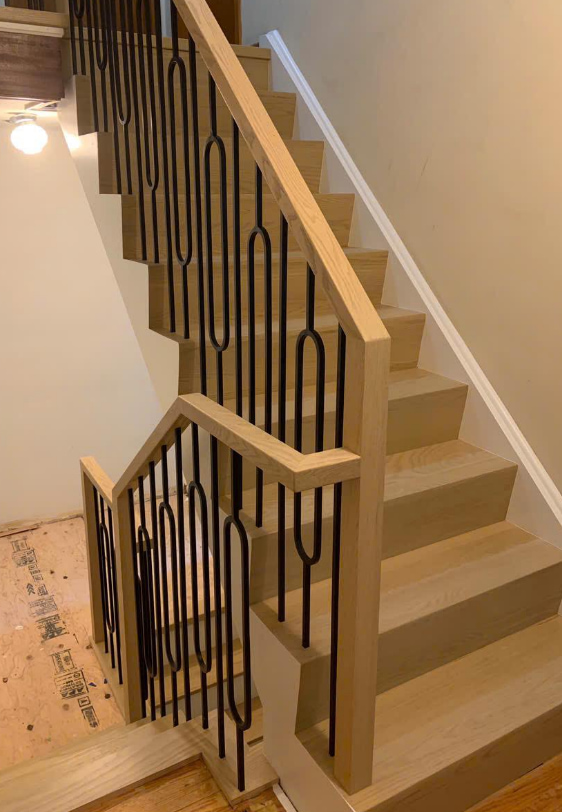
A 90 degree continuous handrail is a specific type of handrail that follows the entire length of a staircase without any breaks and makes right angle turns at landings or corners.

Benefits of 90 Degree Continuous Handrails
A continuous stair handrail with 90 degree turns has many benefits, some of which include:
- Safety — A handrail that is uninterrupted throughout allows people to grip it without having to let go and grasp for a new section as they walk up or down the stairs. This helps reduce the risk of slips or falls.
- Accessibility — For individuals with mobility issues, a railing without breaks provides them with more stable support and makes it easier for them to maintain their balance as they climb the stairs. To ensure accessibility, all handrails must meet ADA compliance standards and Ontario Building Code requirements.
- Aesthetic Appeal — Beyond safety and accessibility, this type of handrail simply looks good and can greatly enhance the visual appeal of a space.
Popular Styles & Where They Work Best
The following are some popular staircase design ideas that you can find inspiration from and may decide you want to implement in your home:
- Sleek Black Handrails — With their clean lines, matte black handrails give your space a sleek and modern look, standing out especially well against light-colored walls.
- Minimalist White Handrails — White handrails provide your stairs with a minimalistic, contemporary look, and they are visually appealing against any wall color, light or dark.
- Wood-Wrapped Handrails — Wood-wrapped handrails offer a more traditional aesthetic with the warmth of wood, while still maintaining the strength and stability of the metal underneath.
- LED-Integrated Handrails — Handrails integrated with LED lights are especially helpful for navigating stairs in low light areas of the home or in the dark at night. They aren’t just great for increased safety, but also for adding an elegant ambience to your space.

Installation Considerations
When it comes to staircase handrail installation, there are a few considerations and challenges that should be taken into account. These include:
- Corners — Installing a handrail at different corners can be quite complicated, particularly when dealing with slope changes because at that point it isn’t just a 90 degree elbow piece that’s needed, but an additional rotation or adjustable elbow.
- Bump-outs/Offsets — There may be offsets, bump-outs, or even ventilation systems that get in the way and that the handrail will need to be built around, which can make the installation process more difficult.
- Custom Dimensions — Making sure that the area and angles of the staircase are measured precisely can be a challenge on its own. There is also the added challenge of a handrail manufacturer possibly measuring differently or needing a custom handrail built instead.
- Labor Intensive — Installing continuous handrails, especially with the challenges outlined above (corners, bump-outs, and custom dimensions), can be quite labor intensive at the end of the day as everything must be done properly and precisely.
- Ontario Building Code — All handrails need to meet Ontario Building Code requirements, which means that they must have a height of 865 to 965 mm (34 to 38 inches), a circular diameter of 30 to 43 mm (1.2 to 1.7 inches), and be securely mounted in order to be easy to hold, as well as properly sustain weight. Handrails must also extend at least 300 mm (12 inches) beyond the top and bottom risers if there isn’t a post or wall that they can be connected to instead.
Pairing with Other Staircase Features
If you just want a simple handrail for stairs on its own, that’s great, but if not, then there are other staircase features that it can be paired, such as:
- Glass Panels — Handrails can be attached to frameless glass panels for a sleek and modern look that is perfect in homes with open-concepts. The glass offers the space an airy feel and allows more light to shine throughout.
- Balusters — Balusters, which are the vertical posts that connect the handrail to the stairs, provide the staircase with additional support and fall protection. They are a timeless feature that works well in both contemporary and traditional spaces.
- Newel Posts — Newel posts are the structural and decorative posts found at the start, end, and turns of a staircase. They can come in a wide variety of shapes and styles to match the handrail, staircase, and the general aesthetic of your home.
- Open Risers — Open risers are another feature that offer your home a more open and airy look and feel. They create the illusion of extra space in the home and provide the staircase with a modern aesthetic overall. However, if your main concern with the staircase is safety, it may be better to stick with closed risers.


Maintenance & Upkeep Tips
To make sure that your handrails continue to look as good as new for as long as possible, keep in mind these following tips:
- Regularly use a soft cloth or microfiber duster to wipe away dust and dirt.
- For a deeper cleaning, apply a mild soap and water solution and dry well to avoid moisture damage.
- Periodically check for loose screws, rust patches, or cracks and immediately fix any problems that you find to keep the damage from worsening.
- Avoid using any abrasive tools or harsh chemicals that can damage the handrail’s surface.
- Apply a polish or sealant to protect against wear and tear.
It’s also important to understand that the way you clean your handrails can change depending on the type of material they are made from. For example, there are different polishes for wooden stair railings and metal stair railings specific to the material, so ensure that you get the one that matches your own railing.
Final Thoughts
Overall, the best handrail for stair safety is undoubtedly one that is continuous with 90 degree turns. While it may require a more labor intensive installation, this type of handrail provides stable support to those who need it and comes in a wide range of styles to match your home’s existing aesthetic. It can also be paired with other staircase features and is fairly easy to maintain.
At Zelta Floor & Design, we are here to help guarantee that your stairs are both beautiful and safe. For more information about our staircase installation and renovation services or to book a free design consultation, contact us today!